
The Reserve Bank on Wednesday retained the GDP growth forecast at 9.5 per cent for the current fiscal but cautioned that the economic recovery is not yet strong enough to be self-sustaining and durable.

A vast majority of the business leaders believe that the Production Linked Incentive (PLI) schemes have been beneficial and expect an extension to other sectors in the coming years, a Deloitte Survey said on Friday. An overwhelming number of survey respondents hope the budget will fuel growth across industries by building strong domestic demand and focussing on capital expenditure and believe that it would define the 'Amrit Kaal'. "Critical to this growth will be the pace of capital expenditure, infrastructure development, and the need to boost infrastructure financing through private partnership. 60 per cent of respondents suggested raising funds through Indian Government Bonds," the survey said.

Double-digits salary hikes are making a post-pandemic comeback on the back of a buoyant business outlook in 2023, according to global professional services firm Aon. Aon's latest "Salary Increase Survey in India" has not only projected a 10.4 per cent average hike across sectors for 2023, but also identified actual hikes in 2022 at 10.6 per cent as against its previous projection of 9.9 per cent in February. The figure of 10.6 per cent is the highest since 2012, whereas the 10.4 per cent levels projected for 2023 were last seen in 2015.

India's services sector activity witnessed a sharp upturn in August on the back of stronger gains in new business, ongoing improvements in demand conditions and job creation, a monthly survey said on Monday. The seasonally adjusted S&P Global India Services PMI Business Activity Index rose from July's four-month low of 55.5 to 57.2 in August, amid a quicker upturn in business activity and the sharpest rise in employment for over 14 years. For the thirteenth straight month, the services sector witnessed an expansion in output.

Within days of announcing mega investments for building in Hyderabad its second data centre cluster in India, Amazon Web Services (AWS) on Monday said it is excited about the India market, where cloud adoption offers massive headroom for growth. Pledging its long-term commitment to the India market, AWS, Amazon's cloud computing unit, said it expects global uncertainties to accelerate the decisions by companies to opt for flexible, on-demand cloud infrastructure to pare costs, gain efficiencies and drive business innovation. "Cloud reacts well to uncertainty," Puneet Chandok, president - commercial business, AWS India and South Asia, Amazon Internet Services Pvt Ltd (AISPL) told PTI.

The Reserve Bank of India on Wednesday retained its growth projection at 7.2 per cent for the current fiscal on the back of improvement in urban demand and gradual recovery in rural India. Unveiling the third monetary policy for the current fiscal, RBI Governor Shaktikanta Das said the Indian economy remained resilient, and the central bank will continue to support growth. The RBI expects growth in the first quarter of the current fiscal at 16.2 per cent, which will taper to 4 per cent by the fourth quarter.

'Valuations are very attractive, and most companies are cash-rich with strong dividend yields.'

There are no bad children, just bad behaviour, insists Bhavana Nagendra.

Equity indices made an emphatic comeback on Friday after falling for seven straight sessions after the RBI hiked interest rates by 50 basis points on expected lines and projected inflation coming under control from January next year. A strong recovery in the rupee added to the momentum, traders said. Overcoming a wobbly start, the 30-share BSE Sensex soared 1,016.96 points or 1.80 per cent to settle at 57,426.92. During the day, it rallied 1,312.67 points or 2.32 per cent to 57,722.63.

Farmer Ishwar Gaykar (36), from Pachghar village in Junnar tehsil of Pune district, had faced a difficult decision of dumping a large quantity of harvested tomatoes in May this year due to low prices.

"It is shameful that Rahul Gandhi, instead of coming to Parliament and apologising for his undemocratic rant against India, today seeks to be absent from Parliament," she asserted.

Software major Tata Consultancy Services on Wednesday reported a 14.8 per cent rise in net income to Rs 11,392 crore for the fourth quarter of last fiscal against Rs 9,959 crore in the year-ago period. The country's largest technology services company by market value said its revenue rose 16.9 per cent to Rs 59,162 crore during the reporting season from Rs 50,591 crore a year ago.

Reserve Bank Governor Shaktikanta Das on Wednesday said in the wake of appreciating US dollar, the movement of rupee has remained least disruptive as compared to its peers, and the size of foreign exchange reserve is comfortable. On a financial year basis (from April to October 2022), the rupee has appreciated by 3.2 per cent in real terms, even as several major currencies have depreciated, he said while announcing the latest set of bi-monthly monetary policy. "The story of the rupee has been one of India's resilience and stability," the Governor said while pointing out that the appreciation of the US dollar this year, which precipitated large-scale depreciation of all major global currencies including the Indian rupee, has drawn wide attention.

The Budget oration of the finance minister and the confidence with which she delivered it, along with the measures and the recent upsurge in the economy would all contribute to unleashing the storied 'animal spirits' and help the economy run on the growth path quite smoothly. Or so the government hopes, notes Shreekant Sambrani.
Enthused by higher than expected GDP numbers in the fourth quarter of 2022-23, Chief Economic Adviser (CEA) V Anantha Nageswaran on Wednesday said India's economic growth may exceed the initial estimate of 6.5 per cent in the current fiscal and the country can look for another year of solid economic performance.

'Building a whole product with the railways was challenging; we had to figure out how to load and unload a train when it stops for only about five minutes at a station.' 'We also helped them understand the revenues this would generate for them.'

'Investors should hold equity assets for 3 to 5 years.'

There are multiple near-term worries for the stock of India's largest listed consumer company, Hindustan Unilever (HUL). While inflationary pressures will weigh on its profitability, demand pressures - especially in the rural market - are expected to hit the firm's revenues. This is why brokerages have cut the earnings estimates for financial year 2022-23 (FY23) by 7-10 per cent.

The seasonally adjusted IHS Markit India Manufacturing Purchasing Managers' Index (PMI) was at 54.9 in February, up from 54.0 in January, signalling a stronger improvement in the sector's health. The February PMI data pointed to an improvement in overall operating conditions for the eighth straight month. In PMI parlance, a print above 50 means expansion, while a score below 50 denotes contraction.

India's aviation industry could return to profitability in 2023-24 for the first time since the pandemic. The industry may pare aggregated net loss by 75-80 per cent year-on-year (YoY) to between Rs 3,500 crore and Rs 4,500 crore in 2022-23 (FY23), compared with Rs 17,500 crore of net losses in 2021-22 (FY22). A combination of recovery in passenger volumes and easing cost pressures due to stable fuel and foreign exchange (forex) costs could spark a turnaround. CRISIL says domestic and international passenger traffic recovered to 90 per cent and 98 per cent, respectively, of pre-pandemic traffic (2019-20, or FY20), in April-December 2022, compared with April-December 2019.

The recent run on the US-based Silicon Valley Bank (SVB) and the subsequent seizure of its assets by the regulators may have sparked a global wave of risk aversion, particularly for start-ups. However, the Indian banking sector is unlikely to be a victim of any contagion effects, said analysts. he bank, which played a big role in financing start-ups and technology players, faced stress after incurring huge losses on its holdings of US bonds, following the most-aggressive monetary tightening cycle by the Federal Reserve in around four decades.

Strong Q3 brings Infosys comfort amid macro risks.

A village gets electricity after 75 years. A rare bird rescued. Why Kashmiris love Harisa. Do watch these interesting videos.
India's economy grew 6.1 per cent in the fourth quarter of 2022-23, pushing up the annual growth rate to 7.2 per cent, official data showed on Wednesday.

Government's focus on infrastructure is the biggest positive for the Indian economy, followed by the improvement in tax collections and good consumption recovery.

Although residential sales faced a major set back in Q2, they made a comeback with help of pent up demand.
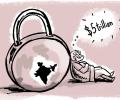
Chief Economic Advisor V Anantha Nageswaran on Thursday expressed hope that the economy will maintain the trend growth rate of 6.5 per cent and above for the rest of the years in the current decade. The economy will close the current fiscal logging in a growth of 6.5-7 per cent, he said, citing the projections of private sector analysts, Reserve Bank of India (RBI) and international agencies like OECD and the IMF. "This appears to be reasonable at this point in time although we will get the data on the fiscal second quarter in a few days, which will give more clarity on these numbers.

Passenger vehicle market leaders Maruti Suzuki and Hyundai on Saturday reported a decline in wholesales in December 2021, although homegrown majors Tata Motors and Mahindra & Mahindra reported growth, amid semiconductor shortage continuing to impact production. Other manufacturers Nissan and Skoda also reported an increase in December 2021 sales although Honda Cars India witnessed a decline last month. The country's largest carmaker Maruti Suzuki India (MSI) reported a 4 per cent fall in wholesales to 153,149 units in December 2021 as against 160,226 units a year ago.

Finance minister Nirmala Sitharaman on Wednesday exuded confidence that inflation would further decline and the government is on track to meet its budgetary target for deficit and said that there is no fear of stagflation in India. Replying to the debate on first batch of Supplementary Demands for Grants 2022-23 in Lok Sabha, the finance minister said inflation has come down and it is now in the tolerable band of the RBI. Inflation has been declining since April 2022 and it is declining further, she said.

After three consecutive years of infusing huge funds, foreign portfolio investors retreated from the Indian equity markets in a big way in 2022 with the highest-ever yearly net outflow of nearly Rs 1.21 lakh crore. The huge outflow, which surpasses by a big margin the previous record of Rs 53,000 crore net withdrawal in 2008, came amid aggressive rate hikes by central banks globally but 2023 is expected to be better on positivity about overall macroeconomic trends in India, experts said. Apart from global monetary tightening, volatile crude, rising commodity prices along with Russia and Ukraine conflict led to an exodus of foreign money in 2022.

India's manufacturing sector activities gained further strength in November, and witnessed the strongest increase in production and sales since February on improving market conditions, a monthly survey said on Wednesday. The seasonally adjusted IHS Markit India Manufacturing Purchasing Managers' Index (PMI), increased from 55.9 in October to 57.6 in November, signalling the strongest improvement in the health of the sector in ten months. Moreover, the headline figure was well above its long-run average of 53.6.

'The classic thing we need as a country is the virtuous cycle where you have robust demand which leads to more capital spending which in turn leads to more job creation and more money in the hands of people.'

Business activity has fallen by a fourth of the pre-COVID levels due to lockdowns imposed by states to contain the spread of the second wave of COVID-19, Japanese brokerage Nomura said on Tuesday. However, it said the falling activity levels will have a muted economic impact and maintained its growth estimates for the year, saying the lockdowns present "downside risks". As of April 25, the Nomura India Business Resumption Index (NIBRI) registered its steepest weekly fall in over a year of 8.5 percentage points to 75.9, which is 24 percentage points below pre-pandemic normal, the brokerage said in a statement.

What matters most is how resilient you are in an ever changing world, advises Sarita Digumarti, chief learning officer, UNext Learning.

AI and machine learning will only continue to grow in 2022, with a significant increase in the demand for such roles, notes Sekhar Garisa, CEO, Monster.com.

The first step to keeping your job safe, experts tell Rediff.com's Divya Nair, is understanding why layoffs happen.

Manufacturing activities in India remained robust and price pressures were contained in October as new orders and production rose at a slower but stronger pace, according to a monthly survey released on Tuesday. The seasonally-adjusted S&P Global India Manufacturing Purchasing Managers' Index (PMI) was up from 55.1 in September to 55.3 in October. The October PMI data pointed to an improvement in overall operating conditions for the 16th straight month.

India has been relatively insulated from the severe headwinds in the West. However, with a third of the global economy expected to slip into recession in calendar year 2023, the impact will strongly be felt on India's exports and trade economy, leading economists said in a panel discussion at the Business Standard BFSI Insight Summit in Mumbai on Wednesday. The panel comprised former Reserve Bank of India executive director and former Monetary Policy Committee member Mridul Saggar, State Bank of India Chief Economic Advisor Soumya Kanti Ghosh, Citibank India Chief Economist Samiran Chakraborty, ICRA Chief Economist Aditi Nayar, and IndusInd Bank Chief Economist Gaurav Kapoor. The topic of the panel discussion was No recession in sight: Is India decoupled from developed economies?

India's economic growth is now 'extremely fragile' and needs all the support that it can get, as private consumption and capital investment are yet to pick up, RBI Monetary Policy Committee (MPC) member Jayanth R Varma said on Friday. Varma further said out of the four engines of growth for the economy, exports and government spending supported the Indian economy through the pandemic, but other engines need to pick up the baton now. " I like to think in terms of the four engines of growth for the economy: exports, government spending, capital investment and private consumption. "...while exports cannot be the main driver of growth because of the global slowdown, government spending is necessarily limited by fiscal constraints," he told PTI.

The ongoing headwinds like war-triggered inflation, rate tightening by RBI and weak rupee will lead to a Rs 60,000 crore increase in 'risky debt' in FY23, a ratings agency warned on Monday. Defining 'risky debt' as borrowings by companies having a net leverage or debt to operating profit ratio of more than five times, India Ratings said the ongoing troubles will take the stock of such loans to Rs 6.9 lakh crore by end of FY23, as against the Rs 6.3 lakh crore it would have been but for the Russian invasion of Ukraine. An analysis of 1,385 corporate entities led the domestic ratings agency to trim revenue growth projection for entities in a post-war scenario and also forecast narrowing of the profit margins due to higher commodity prices, an increase in interest rates of up to 1 per cent and the rupee depreciating by a tenth.
